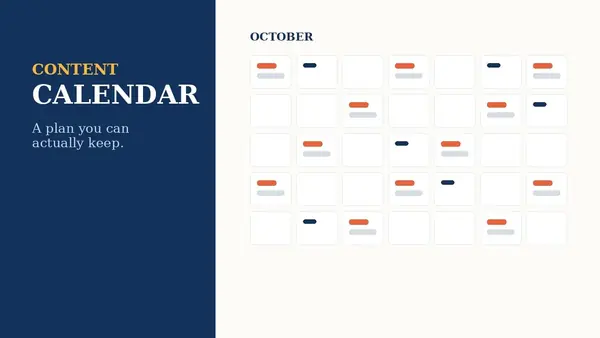
Once a week is the most common answer, and it is usually wrong — not because weekly publishing is bad, but because most teams cannot sustain it, and an abandoned blog is worse than a slow one.
The better question is not "how often" but "how long does a useful post take us, and how many can we finish without lowering the standard?"
Start with capacity, not ambition
Count the hours honestly. A genuinely useful 1,200-word article with research, an outline, a draft and an edit takes most small teams six to ten hours. If you have four hours a week to give, your sustainable rhythm is one post every two weeks — and that is fine.
- 4 hours a month — one short post, or one well-researched post every two months
- 8 hours a month — one solid article
- 16 hours a month — two articles, or one article plus distribution
- Full-time writer — four to eight, depending on research depth
These are planning estimates, not rules. The point is to pick a number you can hit in a bad month, not a good one.
Capacity is easier to judge in words than in hours: paste a draft into the word counter and it returns the reading time a subscriber is actually committing to.
Consistency beats frequency
Search engines do not penalise a blog that publishes twice a month. Readers do notice a blog that published weekly for six weeks and then stopped for a year. A steady rhythm builds a returning audience and keeps the site's content fresh enough to be re-crawled regularly.
Practical consistency looks like this: same day each week or month, a queue of at least four approved topics, and an outline written before the week you plan to publish.
Frequency matters more in some categories
- News and fast-moving topics — weekly or more, because relevance decays quickly.
- How-to and evergreen guides — monthly updates to existing posts often beat new posts.
- High-consideration B2B — one deeply researched piece a month outperforms four thin ones.
- Local services — a handful of strong pages plus monthly updates usually beats a busy blog.
Updating beats adding
An existing article that already ranks on page two is the cheapest traffic you will ever gain. Before writing something new, check what is already published:
- Is the information still accurate?
- Does it answer the question in the first paragraph?
- Are there missing sections that competing pages cover?
- Are internal links pointing to the right pages?
A two-hour refresh of a ranking article frequently produces more value than a brand-new post — and it takes a fraction of the time.
If you can only do one thing this quarter, update the five posts closest to ranking rather than publishing five new ones.
Distribution is part of the schedule
Publishing is half the job. Budget time for the other half: one email to your list, two social posts, one internal link from a relevant page, and a note to anyone mentioned in the piece. If that sounds like too much, publish less often and distribute properly.
A rhythm that survives real life
- Choose one article every two weeks, or one a month if you are solo.
- Keep four approved outlines in reserve so a busy week does not become a blank page.
- Block a two-hour edit slot before publishing — never publish an unedited draft.
- Schedule one refresh per month instead of a new post every fourth slot.
- Review quarterly: which posts earned traffic, and which should be merged or removed.
Signs your frequency is too high
- Drafts are published without an edit pass
- Topics are chosen because they are easy, not because anyone searches for them
- Nobody has time to distribute what is published
- The last three posts repeat the same argument
Any of these means the schedule is running the team instead of the other way round. Cut the frequency, raise the standard.
If the bottleneck is writing time rather than strategy, a monthly article retainer is usually cheaper than hiring — and it keeps the calendar full without taking your week.