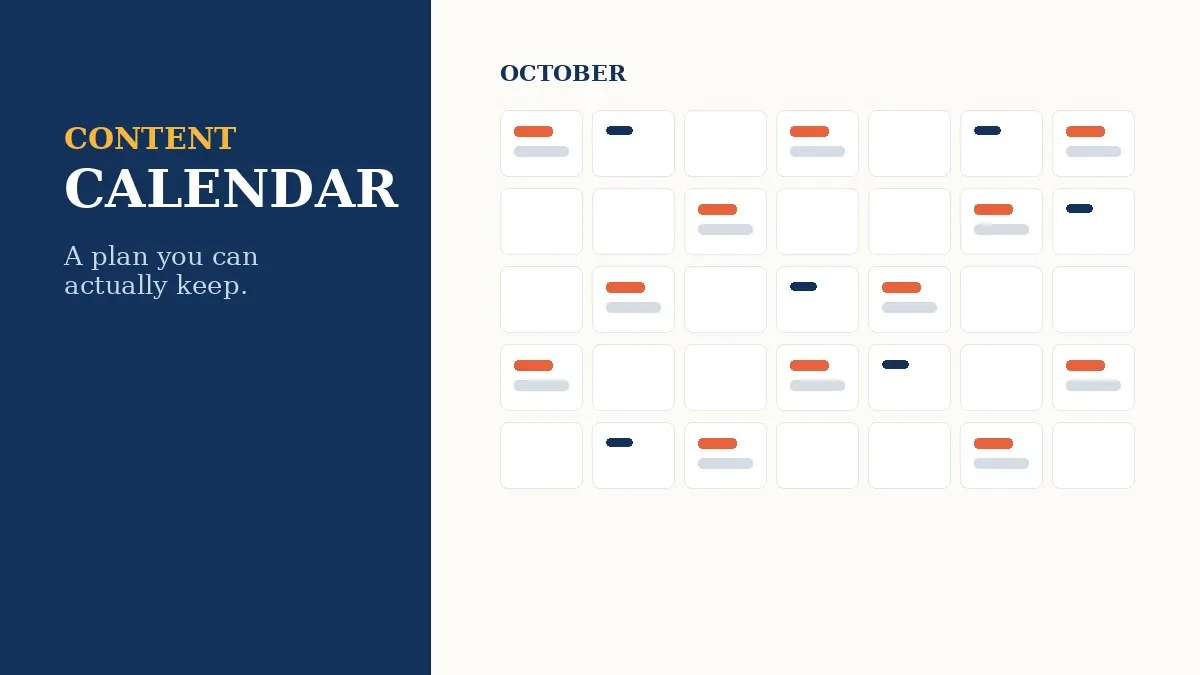
Content calendars fail for boring reasons: they are too detailed, they assume unlimited time, and they have no mechanism for a week going wrong. A calendar that survives is short, owned and slightly under-filled.
Here is the version we use with small teams.
Start with slots, not topics
Decide how many pieces you will publish per month before deciding what they are. Two is a real number. Eight is usually a fantasy. Once the slots exist, filling them is a much easier problem than inventing a strategy from scratch.
- One search article per month — a question people type into Google
- One trust piece per month — how you work, a project story, a comparison
- Optional third: a short update, news reaction or FAQ expansion
That is twelve to twenty-four pieces a year. It is enough to build a topic cluster in a niche, and it is achievable for one person working part-time.
The only fields you need
Every calendar tool tempts you into twenty columns. Six are enough:
- Publish date
- Working title
- Search question it answers — the actual query, in the reader's words
- Primary keyword
- Owner — one name, never a team
- Status — outline approved / draft / edited / scheduled
If you add anything, add a link field so the finished piece connects to the page it should support. Nothing else changes decisions.
Work four weeks ahead
The reliable pattern is a rolling four-week queue: this week is publishing, next week is editing, the week after is drafting, and four weeks out is outlining. When someone is ill or a project explodes, the queue absorbs it — you drop one slot rather than the whole month.
A calendar with a buffer is a plan. A calendar with no buffer is a wish.
Batch the work by type
Switching between research, writing and editing costs more than most people realise. Group similar tasks:
- Monday: research and outlines for two pieces
- Tuesday–Wednesday: drafting, one piece per day
- Thursday: edit pass, images, meta copy
- Friday: schedule, distribute, review what published last week
Two half-days of focused work beat five fragmented hours spread across a week.
Build a topic bank before you need it
Keep a running list of at least ten approved topics. Sources that never run dry:
- Questions from sales calls and contact forms
- Support tickets that repeat
- Search suggestions and "people also ask" results
- Objections that lose deals
- Pages that already rank on page two and deserve expansion
The topic bank is also your insurance against a blank calendar in a busy month.
Give every piece a distribution plan
Publishing is one line on the calendar; distribution is four more. For each article, note:
- One email to your list
- Two social posts, spaced a week apart
- One internal link added from an existing page
- One person or community to share it with
Without this, most content gets one day of attention and then disappears.
Review monthly, prune quarterly
Once a month, look at three numbers per article: impressions, clicks and conversions (enquiry, signup, add-to-cart). Once a quarter, decide what to do with each piece:
- Keep and update — ranks but is dated or thin
- Merge — two posts competing for the same query
- Rewrite — right topic, wrong structure
- Remove — no traffic, no links, no purpose
Deleting content feels wrong and is often correct. Ten focused pages outperform forty forgotten ones.
A template you can copy
Monthly slots: 2 · Queue depth: 4 weeks · Fields: date, title, question, keyword, owner, status · Review: monthly numbers, quarterly pruning · Distribution: 4 actions per post.
If the calendar keeps slipping because writing is the bottleneck, that is the point at which an editorial retainer earns its cost — the plan stays yours, the drafting stops blocking it.